

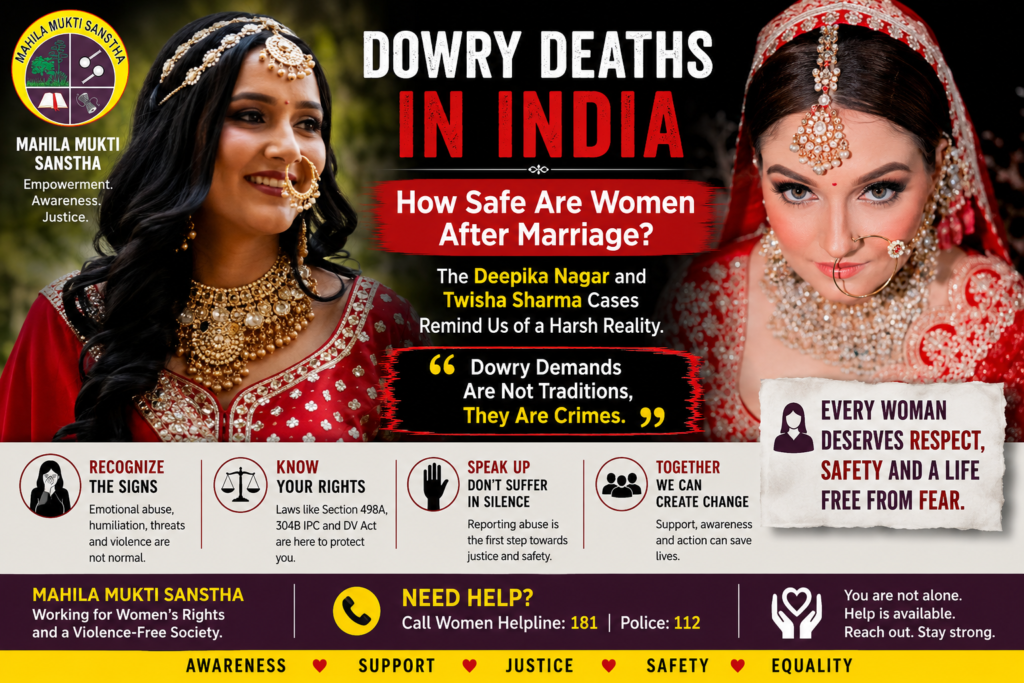
The recent Deepika Nagar dowry death case and Twisha Sharma dowry case have raised once again serious concerns about women’s safety after marriage in India and increasing reports of dowry harassment in India. These are not just family tragedies but are a reflection of a wider social problem linked to domestic violence against married women, emotional abuse, and financial pressure after marriage.
In India, despite stringent dowry laws, many women continue to be subjected to mental harassment, humiliation, and abuse in their marital homes. The talks about Deepika Nagar and Twisha Sharma have also pointed to the significance of women’s protection laws in India, legal awareness, and prompt action in abusive marriages.
Dowry Harassment Allegations and Deepika Nagar Case
Deepika Nagar’s dowry death case from Greater Noida became one of the most talked-about dowry death cases in India in 2026 after her family accused her of constant dowry-related pressure.
Reports suggest that Deepika was put under constant emotional and financial pressure after marriage. Her family said that the matrimonial home was a stressful place due to demands for money and expensive items. The case drew national attention for highlighting the reality of emotional abuse after marriage and the dangers of ignoring early signs of harassment.
A case has been registered in India under laws against dowry harassment and cruelty against married women. Medical findings noted in reports also suggested the possibility of physical violence linked to pressure over dowry.
Latest Legal Updates On Deepika Nagar Case
The probe into the dowry death case of Deepika Nagar is still on. Several accused persons have reportedly been arrested, and police are continuing to look for others connected to the case.
Deepika’s family has demanded a fast-track trial and harsher action under the country’s laws to protect women. Now, the case is being closely watched as it has become a symbol of the rising concern around women’s safety after marriage in India and delays in justice for the victims of abuse.
Twisha Sharma Case & Supreme Court Intervention
The Twisha Sharma dowry case in Bhopal also sparked nationwide conversations on mental harassment post-marriage, emotional trauma, and the silence many women maintain while facing abuse inside marriage.
Her family said that Twisha was under emotional stress and was under dowry pressure soon after marriage. The case attracted a lot of public interest because it raised difficult questions of social pressure, family expectations, and lack of support systems for women going through abuse.
Later, the case reached the Supreme Court of India, making it one of the most important recent discussions around the Supreme Court on dowry death cases and procedural fairness in investigations involving women’s deaths after marriage.
Also read- तलाक लेने में कितना खर्च आता है?
Recent Judgements & Court Proceedings of Twisha Sharma’s case
There have been several important legal developments in the Twisha Sharma dowry case, including:
• Supervision of the investigation by the Supreme Court,
• legal procedures reviewed,
• hearings for anticipatory bail,
• and discussions on the transparency of dowry death probes.
The Court reportedly said women are often discouraged from leaving unsafe marriages early by the fear of divorce stigma and social pressure.
This case has since become a major example in discussions about domestic violence awareness, emotional abuse, and the need for better institutional support for married women.
Dowry Abuse and Domestic Violence in India
Even today, women in rural and urban India continue to face the problem of dowry harassment.
Dowry demands are in many households camouflaged as the following:
• gifts,
• financial assistance,
• marriage plans,
• or the stress of buying expensive things after marriage.
Over time, these demands can result in:
• post-marriage psychological harassments,
• mental abuse,
• family violence,
• shame;
• and financial hardship for women and their families.
Many women are reluctant to report abuse because of the following:
• social judgment,
• financial dependency,
• fear of family argument,
• emotional stress,
• or issues of social reputation.
This silence often results in the abuse continuing for months or even years before any legal action is taken.
Legal Rights Of Wives In India
It is very important to create awareness about the legal rights of married women in India, as many women are not aware of how to seek help during harassment or abuse.
Also read- UN Report 2026 Shocker
Important Dowry Harassment Laws
• Section 498A IPC pertaining to cruelty by husband or relatives
• IPC 304B pertaining to dowry death
• The Dowry Prohibition Act 7.
• Protection of married women from domestic violence laws
These laws are in place to protect women from physical, emotional, and financial abuse relating to marriage and dowry demands.
But in many communities, knowledge about reporting dowry harassment in India is limited.
Also read- POCSO Act
Role of Mahila Mukti Sanstha in Women’s Awareness and Support
Mahila Mukti Sanstha and other organizations working for women’s rights and awareness can play a big role in preventing dowry violence in India and supporting women facing abuse.
NGOs can help in:
• initiatives, women, legal awareness, India NGO
• support for counselling,
• domestic violence awareness campaign,
• programmes of legal education,
• emotional support to women,
• and guidance to married women’s legal help in India.
Community awareness programs can help families to identify the signs of harassment due to dowry after marriage before the situation becomes dangerous.
Why Awareness and Early Reporting Are Important
The Deepika Nagar dowry death case and the Twisha Sharma dowry case are examples that laws alone cannot prevent violence against women.
Families and communities must stop normalizing dowry demands and emotional pressure in marriage. No abuse should be dismissed as just a ‘adjustment issue.’
Women should feel free to talk openly about the following:
• mental abuse,
• financial strain,
• family violence,
• and harassment post-marriage.
But real social change only comes when respect and equality are valued more than social image or financial expectations in marriage.
Also read- POSH Act
Dowry Harassment and Women’s Rights in India FAQs
What is meant by “dowry death” in India?
“Dowry death” is usually referred to as the death of a married woman due to harassment or cruelty by her husband or his relatives in connection with the demand of dowry, usually within seven years of marriage.
What are the usual signs of dowry harassment after marriage?
Some common signs are emotional abuse, continuous demands for money, threats, humiliation, mental stress, and domestic violence for married women.
What is 498A IPC?
Section 498A IPC is a protection provision for married women from cruelty, abuse, and harassment by husbands or relatives.
What is the relevance of the Twisha Sharma case?
The Twisha Sharma dowry case turned into a national issue when the Supreme Court intervened after doubts were raised about the investigation procedures and fairness.
What is the latest in the Deepika Nagar case?
The dowry death case of Deepika Nagar is still under investigation, and many of the accused have reportedly been arrested, and the family is demanding a fast-track trial.
Can I report emotional abuse after marriage legally?
Yes. Emotional abuse, humiliation, threats and mental harassment after marriage can be considered as cruelty too under Indian law.
Conclusion
The dowry death in Deepika Nagar and the dowry case of Twisha Sharma are painful reminders of the fact that dowry harassment continues to be a serious social issue in India, despite strict laws and awareness campaigns.
These cases highlight the critical need for increased awareness around women’s safety after marriage in India, emotional well-being, legal rights, and early reporting of abuse.
The media attention to dowry death cases in India in 2026 must not stop when the media attention stops. Real change needs awareness, legal accountability, community support, and respecting women’s dignity in every household.”