

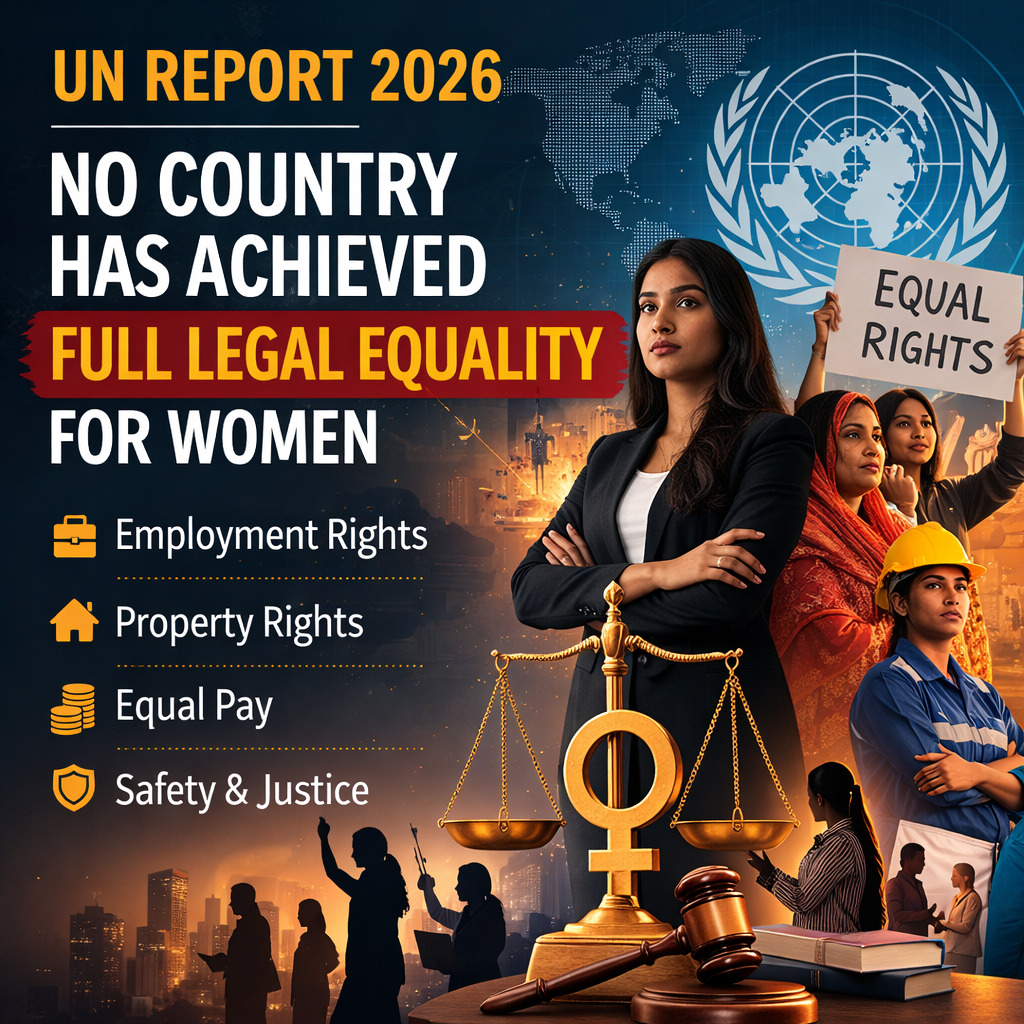
Gender equality remains one of the most discussed global issues, yet a new report from the United Nations confirms a startling reality — no country in the world has achieved full legal equality for women.
Released around International Women’s Day 2026, the report highlights major gaps in women legal rights, women economic rights, and protections against gender inequality. Despite decades of reforms, legal equality for women continues to be incomplete across all nations.
This latest UN report on women rights has reignited global debate about whether governments are doing enough to eliminate gender discrimination laws and ensure equal rights.
Gender Equality Still a Global Challenge
While progress has been made, gender equality remains far from reality. According to the United Nations, women still face legal barriers in employment, property ownership, family law, and financial access.
The report emphasizes that women legal equality is not only about policy announcements but about removing structural barriers embedded within legal systems.
Even developed nations with progressive policies have gaps in women workplace rights, inheritance laws, and equal economic participation. The concept of women rights globally remains uneven and inconsistent.
Women Economic Rights and Legal Inequality
A key reference in the discussion of women economic rights is the Women, Business and the Law Report, published by the World Bank.
This global gender equality report measures how laws impact women’s participation in the economy. It finds that women worldwide enjoy significantly fewer legal rights compared to men in areas such as:
- Employment opportunities
- Access to credit and banking
- Business ownership
- Property and inheritance rights
- Pension and social protection
In many countries, women property rights are limited either legally or culturally. Even where laws guarantee equal rights, implementation gaps reduce their effectiveness.
The global gender gap in legal protection directly impacts economic growth. Without equal women economic participation, societies cannot achieve sustainable development.
Equal Pay for Women and Workplace Barriers
One of the strongest indicators of gender inequality is the persistent wage gap. Although many countries have passed laws promoting equal pay for women, enforcement mechanisms remain weak.
Women often face discrimination in hiring, promotions, and leadership opportunities. Women workplace rights related to maternity leave, safety from harassment, and job security vary widely across regions.
The lack of consistent enforcement of gender discrimination laws prevents women from fully benefiting from economic systems.
Violence Against Women Worldwide
Legal equality also means protection from violence. The United Nations reports that millions of women continue to face domestic abuse, sexual harassment, and other forms of violence.
Although legislation exists in many nations, violence against women persists due to weak implementation and social stigma.
Without strong accountability systems, women legal rights worldwide remain theoretical rather than practical.
Which Country Has Full Legal Equality for Women?
The answer, according to the United Nations, is clear: none.
No country has yet achieved complete legal equality for women across all indicators — including employment, property rights, family law, and safety protections.
This finding challenges the global community to rethink progress narratives around gender equality.
Why Gender Equality Is Important for Global Growth
Experts stress that gender equality is not only a human rights issue but also an economic necessity.
When women legal rights are strengthened:
- Household incomes increase
- Poverty rates decline
- Economic productivity rises
- Social stability improves
Studies show that closing the global gender gap could add trillions to the global economy. Ensuring full legal equality for women is therefore essential for long-term development.
Progress Made — But Not Fast Enough
There have been measurable improvements:
- Stronger anti-discrimination laws
- Expansion of maternity benefits
- Increased female political representation
- Greater access to education
However, the pace of reform remains slow. The 2026 UN report on women rights makes it clear that achieving women legal equality requires urgent policy reform and stronger enforcement.
The Way Forward: Strengthening Women Legal Rights Worldwide
To achieve real gender equality, governments must:
- Reform outdated and discriminatory laws
- Strengthen enforcement of gender discrimination laws
- Expand access to justice for women
- Improve monitoring systems
- Promote awareness and social change
Without these measures, women rights globally will remain incomplete.
Conclusion: Legal Equality for Women Is Still Unfinished
The 2026 findings confirm a sobering truth — legal equality for women has not been fully achieved anywhere in the world.
Despite progress in women economic rights, workplace protections, and political participation, systemic gaps persist.
As the world reflects after International Women’s Day, the global message is clear: gender equality must move from promise to practice.
True development cannot occur until women legal rights worldwide are fully guaranteed and implemented.
FAQs
What does the UN report say about gender equality?
The United Nations confirms that no country has achieved full legal equality for women across all sectors.
Which report tracks women economic rights?
The Women, Business and the Law Report by the World Bank measures global women economic rights.
Why is legal equality for women important?
Legal equality for women boosts economic growth, reduces poverty, and strengthens democratic systems.
Has any country achieved complete women legal equality?
No. According to the 2026 global gender equality report, full legal equality for women remains unachieved worldwide.