

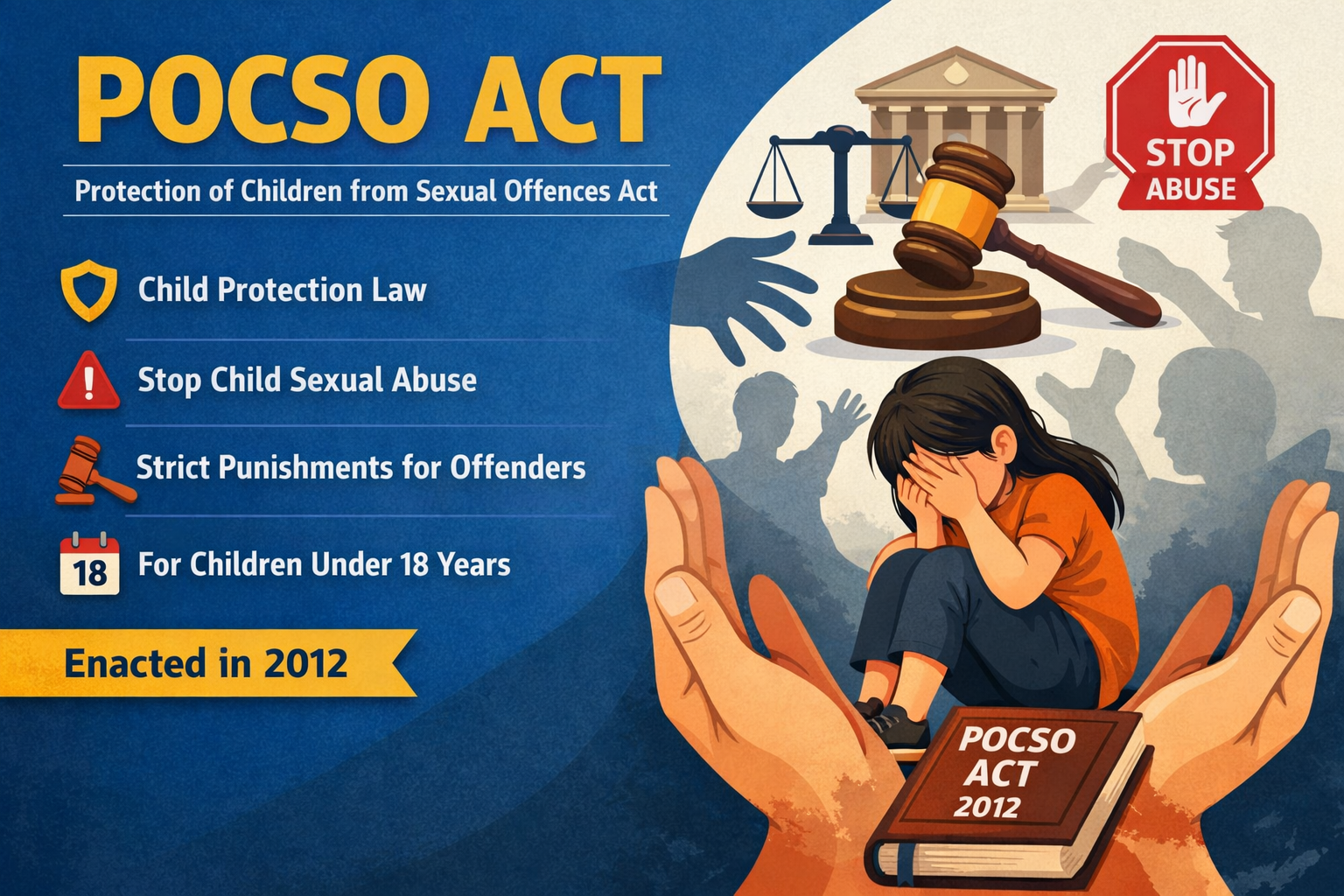
Children deserve safety, dignity, and protection at every stage of life. Unfortunately, cases of child sexual abuse and exploitation have raised serious concerns across the country. To address this growing issue and provide a strong legal framework for child protection, the Government of India enacted the Protection of Children from Sexual Offences Act, commonly known as the POCSO Act.
Introduced in 2012, this landmark child protection law aims to safeguard minors from sexual offences, ensure strict punishment for offenders, and create a child-friendly judicial process. The Act plays a critical role in protecting child rights in India and strengthening the legal system against crimes involving minors.
What is the POCSO Act?
The POCSO Act is a special law designed to protect children below the age of 18 years from sexual abuse, sexual harassment, and exploitation. It was enacted to address the gaps in existing laws and to provide a clear, comprehensive legal structure specifically focused on crimes against children.
Key Features of the POCSO Act
1. Definition of a Child
The Act clearly defines a “child” as any person below 18 years of age. This definition is uniform and applies across all cases under the Act.
2. Gender-Neutral Law
Unlike many earlier laws, the POCSO Act is gender-neutral. It protects both boys and girls from sexual offences, recognizing that children of any gender can be victims.
3. Clear Definitions of Offences
For the first time in Indian legal history, specific definitions were provided for offences such as:
- Penetrative sexual assault
- Sexual assault
- Sexual harassment
- Use of children for pornography
These clear definitions reduce ambiguity and strengthen prosecution.
4. Child-Friendly Procedures
One of the most important aspects of the POCSO Act is its child-sensitive approach. The law ensures:
- The child’s statement is recorded in a safe and comfortable environment.
- Police officers do not wear uniforms while recording statements (in many cases).
- The identity of the child is kept confidential.
- Medical examinations are conducted sensitively.
- Special courts conduct fast-track trials to ensure speedy justice.
5. Aggravated Offences
The Act recognises aggravated sexual assault when committed by individuals in positions of authority, such as:
- Police officers
- Public servants
- Hospital staff
- Teachers or school staff
- Family members
Punishments in such cases are more severe due to breach of trust and authority.
What is the punishment for POCSO in India?
Punishment under the POCSO Act depends on the seriousness and nature of the offence. The law provides strict penalties to act as a deterrent and ensure justice for victims.
Types of Punishments Under POCSO
- Sexual Harassment:
Imprisonment up to 3 years and/or fine. - Sexual Assault:
Imprisonment of 3 to 5 years, along with a fine. - Aggravated Sexual Assault:
Imprisonment of 5 to 7 years, which may extend further depending on circumstances. - Penetrative Sexual Assault:
Minimum 10 years imprisonment, which may extend to life imprisonment. - Aggravated Penetrative Sexual Assault:
Minimum 10 years to life imprisonment.
After the 2019 amendment to the Act, the death penalty can also be awarded in extremely severe cases involving aggravated penetrative sexual assault.
These strict punishments highlight the seriousness with which child sexual abuse is treated under Indian law.
Is the POCSO Act bailable?
Whether an offence under the POCSO Act is bailable or not depends on the severity of the crime.
Non-Bailable Offences
Most serious offences under the POCSO Act are non-bailable, particularly:
- Penetrative sexual assault
- Aggravated penetrative sexual assault
- Aggravated sexual assault
In non-bailable offences:
- The accused does not have an automatic right to bail.
- Bail is granted only by the court after examining the facts of the case.
- The safety and welfare of the child remain the top priority.
Bailable Offences
Certain minor offences under the Act may be considered bailable. For example:
- Failure to report an offence (Section 21), which carries imprisonment of less than three years.
In 2023, the Himachal Pradesh High Court clarified that where the POCSO Act does not clearly specify whether an offence is bailable or non-bailable, the provisions of the Code of Criminal Procedure (CrPC) apply. Offences punishable with less than three years of imprisonment are generally treated as bailable.
However, courts always consider the best interests of the child before granting bail.
What is the age limit for POCSO?
The age limit under the POCSO Act is clearly defined. The Act applies to any individual below the age of 18 years.
Uniform Definition of “Child”
A child is any person under 18 years of age, regardless of gender.
Legislative Intent Behind the Age Limit
The age of 18 has been intentionally chosen to maintain consistency with other Indian laws such as:
- The Juvenile Justice Act
- The Prohibition of Child Marriage Act
The purpose is to protect minors from coercion, manipulation, and exploitation. Under the POCSO Act, consent given by a minor is not considered legally valid. Any sexual act involving a person under 18 years falls within the scope of the Act.
This strict age limit ensures comprehensive child protection across India.
Importance of the POCSO Act in Society
The POCSO Act plays a transformative role in strengthening child protection laws in India. Its importance can be understood through the following points:
- Protects children from sexual exploitation and abuse
- Encourages early reporting of offences
- Provides a child-friendly legal process
- Ensures strict punishment for offenders
- Promotes awareness about child rights
The Act has also increased public awareness about child safety and legal remedies available to victims.
Non-governmental organizations (NGOs), schools, and social institutions play a significant role in spreading awareness about the POCSO Act. By conducting awareness programs, legal literacy sessions, and counselling support, they help create a safer environment for children.
Conclusion
The POCSO Act stands as one of the strongest child protection laws in India. By clearly defining offences, ensuring strict punishment, and adopting child-sensitive procedures, it provides a comprehensive legal shield for minors.
However, laws alone are not enough. Awareness, education, and responsible reporting are equally important in preventing child sexual abuse. Parents, teachers, community members, and organizations must work together to ensure children grow up in a safe and secure environment.
Protecting children is not just a legal duty—it is a social responsibility.
Frequently Asked Questions (FAQs) on POCSO Act
1. What is the POCSO Act in India?
The Protection of Children from Sexual Offences Act is a special child protection law enacted in 2012 to safeguard children below 18 years from sexual abuse, harassment, and exploitation.
2. What is the punishment under the POCSO Act?
Punishment depends on the nature of the offence. It ranges from 3 years imprisonment for sexual harassment to life imprisonment or death penalty in aggravated cases.
3. Is POCSO a bailable offence?
Most serious offences under the POCSO Act are non-bailable. Bail is granted only by the court after careful consideration. Minor offences punishable with less than three years may be bailable.
4. What is the age limit under the POCSO Act?
The Act applies to any person below 18 years of age. Consent of a minor is not legally valid under this law.
5. Is the POCSO Act gender-neutral?
Yes. The Act protects both boys and girls from sexual offences.
6. When was the POCSO Act introduced?
The POCSO Act was enacted in 2012 and later amended in 2019 to strengthen punishment for serious offences.